
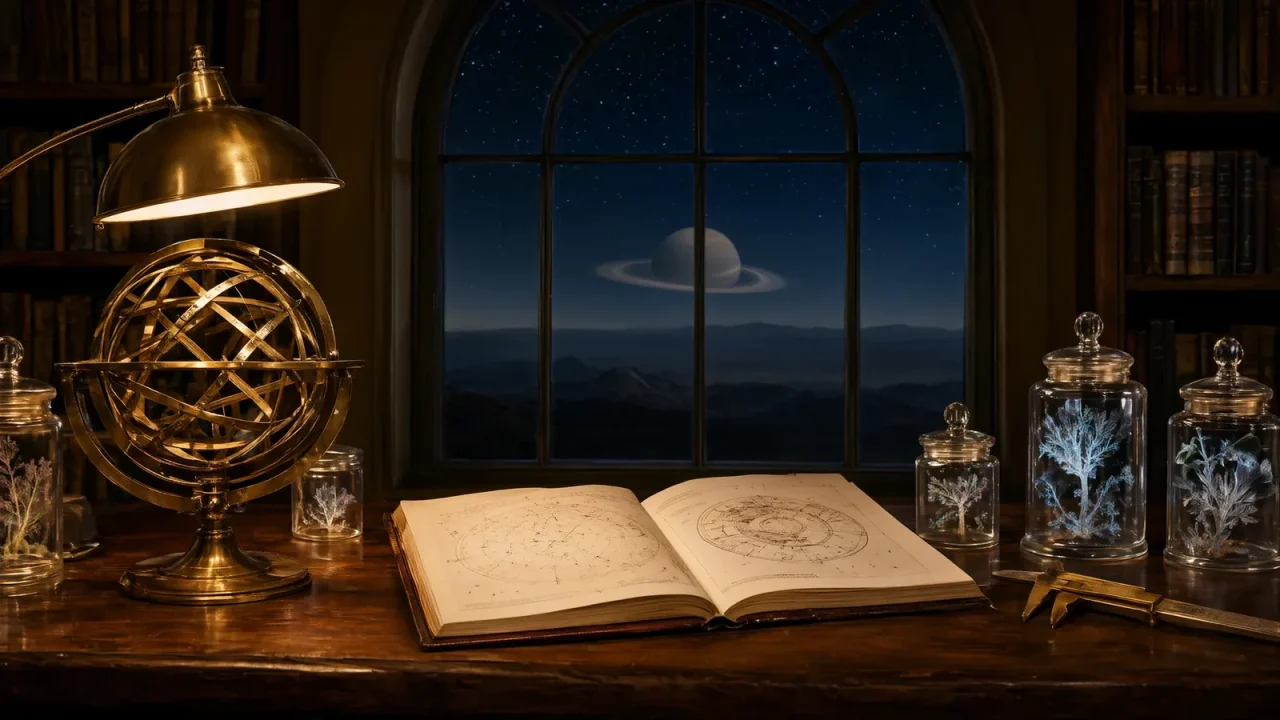
Defining the Speculative Fiction Umbrella
Speculative fiction serves as the overarching classification for narratives that intentionally step outside ordinary realism to construct altered natural laws, divergent timelines, alien biospheres, or transformative technologies. Rather than operating as a narrow bookstore shelf, this umbrella spans literature, cinema, television, stage drama, video games, radio, and hybrid formats. Whenever a creator asks what unfolds if physical rules bend, if recorded history splits, or if biology radiates along an unfamiliar path, the resulting narrative enters this broader canon.
Literary scholars clarify the domain by contrasting it against realistic prose and 19th-century literary realism. Realistic storytelling—including traditional historical novels—anchors characters in settings and events that could plausibly unfold within consensus reality. Non-mimetic canons relax everyday constraints along three main axes: building autonomous secondary cosmoses where natural laws shift (fantasy), altering pivotal historical outcomes (alternate history), or projecting engineering capabilities beyond current science (science fiction).
Terminology around speculative fiction still invites critical debate. Readers routinely encounter shorthand such as spec-fic, specfic, S-F, or SF, yet the shorter initials blur into longstanding abbreviations for science fiction alone. In 2007, critic John Clute proposed fantastika—adapted from Slavic literary discourse—as an unambiguous umbrella name, while suppositional fiction denotes narratives bound tightly by an internally coherent premise regardless of commercial genre tags.
Two influential authorial definitions illustrate how differently writers frame speculative fiction:
- Expansive literary openness: Harlan Ellison championed the label to avoid being boxed in as a conventional science-fiction writer, steering authors toward modernist craft and thematic freedom beyond textbook genre rules.
- Grounded extrapolation: Margaret Atwood famously framed the term as “no Martians” storytelling—reserving it for biological, political, or technological shifts that could plausibly materialize.
Modern archives favor the inclusive sense, bringing scientific extrapolation, mythic world-creation, supernatural dread, and cross-genre hybrids under one comparative canopy.
Taxonomy of Major Speculative Subgenres
Codex editors classify branches of speculative fiction by identifying which layer of empirical reality each tradition modifies—physics, evolutionary lineage, historical causality, cosmic dread, or civic ecology. The reference matrix below maps eight primary divisions.
| Subgenre | Core Departure from Realism | Notable Milestones | Worldbuilding Emphasis |
|---|---|---|---|
| Science Fiction | Extrapolated engineering, planetary physics, or future social systems | The Time Machine (1895); Last and First Men (1930); Dragon’s Egg (1980) | Scientific causality, energy systems, technological ripple effects |
| Fantasy & Mythopoeia | Secondary worlds, supernatural rules, mythic pantheons, or folkloric beings | A Midsummer Night’s Dream; The Lord of the Rings | Invented languages, mythic historiography, metaphysical limits |
| Speculative Evolution | Hypothetical future, alternate-Earth, or alien organisms grounded in biology | After Man (1981); The New Dinosaurs (1988); Expedition (1990) | Anatomy, biome adaptation, cladistics, convergent traits |
| Alternate History | A documented Point of Divergence rerouting recorded human events | P.’s Correspondence (1845); Aristopia (1895); Bring the Jubilee (1953) | Geopolitical branching, institutional inertia, causal plausibility |
| Weird & New Weird | Indifferent outer phenomena suspending natural law beyond Gothic tropes | Weird Tales (1923–1954); H. P. Lovecraft; China Miéville; VanderMeers | Atmospheric dread, numinous awe, hybrid urban monstrosity |
| Utopia, Dystopia & Counter-Dystopia | Systemic reimagining of governance, civic justice, or ecological survival | Looking Backward: 2000–1887; 1984 (1949); Solarpunk | Political economy, resource stewardship, civic transition |
| Supernatural Horror | Paranormal entities or occult violations threatening empirical safety | Dracula; Sheridan Le Fanu; M. R. James; Clive Barker | Epistemic instability, ritual constraints, psychological terror |
| Slipstream & Science Fantasy | Cross-pollination combining realistic texture, magic, mystery, and futuristic tools | Invisible Cities (1972); Parallel Botany (1976); hybrid modern canons | Tonal juxtaposition, conceptual framing, fluid genre rules |
New movements continue to crystallize inside this ecosystem. Ecological sub-traditions like solarpunk invert bleak dystopian scripts by uniting renewable infrastructure with participatory community design, demonstrating how speculative fiction evolves alongside shifting cultural anxieties.
Historical Evolution From Antiquity to the 21st Century
Imaginative departures from empirical fact predate modern publishing shelves by millennia. Historians note one vital caveat when citing classical ancestors: ancient playwrights and chroniclers did not write under modern genre labels, yet their methods forged the formal toolkit of speculative fiction.
In classical Athens, dramatist Euripides (c. 480–c. 406 BCE) unsettled audiences with Medea by altering prevailing Corinthian tradition so the sorceress deliberately kills her own children instead of losing them to civic retaliation. Early historiography likewise blended documentation with hypothetical storytelling: Herodotus of Halicarnassus (5th century BCE) wove speculative passages through his Histories, while Han-dynasty historian Sima Qian (c. 145 or 135–86 BCE) actively edited out ahistorical legends while assembling the Shiji.
Renaissance criticism retrospectively labeled comparable liberties historical invention. William Shakespeare’s A Midsummer Night’s Dream deliberately gathers figures from incompatible eras into Oberon’s woodland realm—placing Athenian duke Theseus and Amazon queen Hippolyta alongside English sprite Puck and Roman deity Cupid. Centuries later, J. R. R. Tolkien gave comprehensive mythic creation its lasting label, mythopoeia, proving through The Lord of the Rings how invented languages and deep legends sustain an entire fictional universe.
In English print criticism, the explicit phrase speculative fiction progressed across four documented stages:
- Early print citations (1889–1900): An 1889 essay in Lippincott’s Monthly Magazine invoked the term for Edward Bellamy’s utopian novel Looking Backward: 2000–1887, and May 1900 commentary in The Bookman noted keen discussion of John Uri Lloyd’s Etidorhpa among readers of speculative prose.
- Heinlein’s codification (1947): On 8 February 1947, Robert A. Heinlein popularized capitalized Speculative Fiction in a Saturday Evening Post editorial as a synonym for science fiction, later stating explicitly that his definition excluded fantasy.
- New Wave expansion (1960s–early 1970s): Editor Judith Merril and New Wave contributors adopted the banner to critique formulaic establishment science fiction and champion literary ambition before momentum cooled during the mid-1970s.
- Umbrella consensus (2000s onward): Entering the 2000s, critics, anthologists, and digital databases adopted speculative fiction as an inclusive heading for multi-genre story worlds uniting sci-fi, fantasy, horror, and mystery.
Three Deep-Time Pillars: Evolution, Divergence & Cosmic Dread
Beyond commercial space opera and heroic fantasy, three rigorous branches demonstrate the analytical depth of speculative fiction: biologically grounded evolution, historical divergence modeling, and cosmic weirdness.
Speculative Evolution and Fictional Biology
Often treated as hard science fiction because it grounds imaginary lifeforms in evolutionary theory and biomechanics, speculative evolution (also called speculative biology or speculative zoology) projects organisms across future Earths, alternate timelines, or exoplanets. Its literary prototype is H. G. Wells’s The Time Machine (1895), set over 800,000 years ahead with post-human Eloi and Morlocks alongside giant crabs and butterflies.
Twentieth-century pioneers moved fictional ecology from background detail to cohesive ecosystems. Edgar Rice Burroughs sustained alien worlds across ten Martian Barsoom novels (1912–1948) and five Venusian Amtor novels (1934–1964). In 1930, Olaf Stapledon’s Last and First Men spanned two billion years and eighteen human species, anticipating genetic engineering and group minds. During the mid-1930s, Stanley Weinbaum broke pulp clichés by giving extraterrestrials genuinely non-human drives—a shift Frederik Pohl celebrated for moving past costumed humans. Conceptual landmarks also include German zoologist Gerolf Steiner’s playful 1957 monograph Rhinogradentia (The Snouters), detailing island mammals with adaptive nose-organs called nasoria, and Leo Lionni’s Parallel Botany (1976), often paired with Italo Calvino’s Invisible Cities (1972) and its 55 imagined cities.
British paleontologist Darren Naish termed the contemporary boom the “Speculative Zoology Movement,” anchored by Dougal Dixon’s illustrated 1981 landmark After Man. Projecting niches after humanity’s disappearance, Dixon populated a future biosphere of over 100 species shaped by convergent evolution. He followed with The New Dinosaurs (1988)—drawing on zoogeography and energetic, feathered-dinosaur insights from paleontologists Robert Bakker and Gregory S. Paul—and examined climate impacts across Man After Man (1990) and Greenworld (2010).
Rigorous fictional biology intersects directly with education and empirical science:
- Predictive paleoart: Artist John Meszaros illustrated a filter-feeding radiodont named Ceticaris in 2013’s All Your Yesterdays (co-authored by Darren Naish, C. M. Kosemen, and John Conway). In 2014, fossils confirmed that the Cambrian radiodont Tamisiocaris truly fed by filtration, honoring Meszaros through the clade name Cetiocaridae.
- Exobiological modeling: Carl Sagan and Edwin Salpeter outlined a “hunters, floaters and sinkers” gas-giant atmosphere in 1976. Robert Forward’s Dragon’s Egg (1980) depicted neutron-star cheela evolving a million times faster than humans amid iron-vapor skies and mountains 5 to 100 millimeters high, while Wayne Barlowe’s Expedition (1990) charted Darwin IV (adapted as 2005’s Alien Planet featuring James B. Garvin, Jack Horner, and Michio Kaku).
- Pedagogy & cinema: Educators classify Joseph H. Camin’s 77 invented Caminalcules to teach phylogenetics, museums have mounted exhibits around After Man and The Future is Wild (2002), and cinema drew on parasitoid wasps for Alien (1979) and multidisciplinary biology consultants for Avatar (2009). Independent artists arriving at matching alien traits from identical physics produce what theorists call “convergent speculation.”
Alternate History and Point-of-Divergence Architecture
Alternate history (allohistory or althist) examines historical “what if” scenarios requiring three pillars: a Point of Divergence (POD) predating the work’s composition, a decisive change altering subsequent events, and rigorous analysis of downstream consequences. Those criteria separate it from secret history, academic counterfactual essays, and future projections whose dates later arrived—such as George Orwell’s 1984 (published in 1949), Arthur C. Clarke’s 2001: A Space Odyssey (1968), or the 2009 film 2012.
Pre-modern precursors span Livy’s Roman chronicle Ab Urbe Condita Libri (pondering a 4th-century BC war between Rome and Alexander the Great), Peter Damian’s 11th-century De Divina Omnipotentia, and Joanot Martorell’s 1490 epic Tirant lo Blanch, which averts Constantinople’s fall. Modern landmarks crystallized in the 19th century through Louis Geoffroy’s 1836 Napoleonic conquest novel (diverging in 1812 and 1814), Nathaniel Hawthorne’s 1845 “P.’s Correspondence” (the first complete English short story in the form), and Castello Holford’s Aristopia (1895, the first English alternate-history novel).
Twentieth-century writers expanded divergence into a major narrative engine. H. G. Wells pioneered cross-world transit in A Modern Utopia (1905) and multiverse travel 3,000 years ahead in Men Like Gods (1923). After James Thurber satirized Civil War counterfactuals in 1930, Sir John Squire edited the 1931 essay anthology If It Had Happened Otherwise—including Winston Churchill’s “recursive alternate history” written from a Confederate-victory timeline imagining a Union win. Pulp fiction turned branching realities into kinetic plot devices through Nat Schachner’s “Ancestral Voices” (December 1933), Murray Leinster’s “Sidewise in Time” (1934, namesake of the Sidewise Award), and Robert A. Heinlein’s Elsewhen (1941).
Mid- and late-century stories added time-travel causation and quantum multiverses:
- Timeline interventions: L. Sprague de Camp’s Lest Darkness Fall, William Tenn’s Brooklyn Project (1948), Ray Bradbury’s “A Sound of Thunder” (1952), Ward Moore’s Bring the Jubilee (1953), and Stephen Fry’s Making History probe how single changes fork or overwrite civilizations.
- Paratime empires & ethics: Fritz Leiber’s Hugo-winning The Big Time (1958) launched cross-time warfare alongside H. Beam Piper’s Lord Kalvan, Keith Laumer’s Imperium sequence, Michael Kurland’s Perchance (1988), and Harry Turtledove’s six-book Crosstime Traffic. Philosophically, Larry Niven’s “All the Myriad Ways” dramatized despair under infinite branching, while physicist David Deutsch argued that ethical choices enlarge the measure of desirable universes—echoed in Greg Egan’s “The Infinite Assassin.”
Weird Fiction, Cosmic Dread, and the New Weird
Weird storytelling took shape across the late 19th and early 20th centuries by rejecting or mutating familiar Gothic monsters like vampires and ghosts. China Miéville adopted “the tentacle” as its emblem and echoed Goethe in describing how weird tales summon the numinous—a blend of terror and awe. Critics map complementary angles: John Clute stresses transgressive macabre fantasy, Jeffrey Andrew Weinstock highlights human impotence before vast malign powers, and Ann and Jeff VanderMeer frame weird writing as an atmospheric mode rather than a sealed commercial compartment.
Reviewers applied “weird” to unsettling supernatural writing by 1859—when the Scottish Review praised Walter Scott, E. T. A. Hoffmann, and Edgar Allan Poe—and in 1898, when The Freeman’s Journal called Bram Stoker’s Dracula “wild and weird” rather than Gothic. Scholars S. T. Joshi and Miéville designate 1880 to 1940 as “Haute Weird.” British pioneers included Arthur Machen alongside M. R. James, Lord Dunsany, Algernon Blackwood, and William Hope Hodgson, while American pulp publishing centered on Weird Tales (March 1923–September 1954, edited by Farnsworth Wright), publishing Robert Bloch, Fritz Leiber, Clark Ashton Smith, and H. P. Lovecraft. In “Supernatural Horror in Literature,” Lovecraft grounded true weird dread in a serious suspension of fixed natural laws. Following later voices like Clive Barker and Ramsey Campbell, a major revitalization arrived in the 1980s and 1990s as the New Weird, sustaining boundary-crossing prose throughout the 21st century.
Structural Craft in Speculative Worldbuilding
Durable speculative fiction depends on disciplined world-architecture. First, internal consistency outranks everyday realism: readers accept alien anatomy or impossible physics whenever a narrative obeys its declared axioms. Second, second-order extrapolation transforms a lone concept into a living culture; changing one energy source or biological limit ripples across commerce, architecture, and ritual.
Third, multi-book canons and tabletop worlds require structured documentation to prevent continuity drift. Pairing design methodology with dependable worldbuilding tools—local Markdown graphs, relational wikis, and procedural cartography—keeps timelines and ecologies aligned as projects expand. Fourth, deliberate tonal calibration ensures world mechanics serve theme, from cosmic smallness in weird horror to collective agency in counter-dystopian solarpunk.
Publishing Landscape, Research Databases & Scholarship
Speculative fiction is supported by durable bibliographic and scholarly institutions. Researchers and readers consult the Internet Speculative Fiction Database to verify editions and granular subgenre listings, while peer-reviewed journals including Extrapolation and Foundation anchor academic criticism.
English-language publishing data reveals sharp demographic differences across branches rather than one flat ratio. Overall, male writers pursuing professional publication outnumber female writers by roughly two to one. Within distinct sectors, however, that balance flips: women outnumber men across young adult titles, paranormal romance, and urban fantasy—showing how diverse readerships continually reshape the field’s artistic and commercial center.
Frequently Asked Questions
How does speculative fiction differ from science fiction?
Science fiction is one major division inside the broader umbrella, anchored in extrapolated engineering, physics, or biology. Speculative fiction also spans fantasy, supernatural horror, alternate history, weird tales, and genre hybrids that do not require strict scientific rationale.
Who first coined the phrase in print?
Robert A. Heinlein popularized capitalized Speculative Fiction in a 1947 Saturday Evening Post editorial as a synonym for science fiction excluding fantasy. Earlier print citations, however, appear in an 1889 Lippincott’s Monthly Magazine essay on Edward Bellamy’s Looking Backward: 2000–1887 and a May 1900 notice in The Bookman.
Does fantasy belong under the speculative umbrella?
Yes. Although Heinlein excluded fantasy in 1947, contemporary literary criticism, anthologies, and bibliographic databases treat fantasy—including mythopoeia, urban fantasy, and science fantasy—as a core pillar of the umbrella.
Why are Orwell’s 1984 and Clarke’s 2001 not alternate history?
Alternate history requires a Point of Divergence located in the past relative to when the author wrote. Because George Orwell published 1984 in 1949 and Arthur C. Clarke published 2001: A Space Odyssey in 1968, both are futuristic projections rather than divergences from known history.
How do scientists and educators use speculative evolution?
Because it applies real anatomy, ecology, and cladistics to hypothetical lifeforms, educators use Joseph H. Camin’s 77 Caminalcules and museum exhibits of After Man to teach evolutionary principles. Disciplined extrapolation even anticipated fossil findings when John Meszaros’s 2013 filter-feeding radiodont preceded the 2014 confirmation of Tamisiocaris.
What separates weird fiction and alternate history from standard fantasy?
Alternate history anchors its divergence in a documented past event rather than a secondary world, while weird fiction unsettles fixed natural laws to evoke awe and terror beyond conventional Gothic monsters.
Sources & Archival Attribution
- Speculative fiction — Wikipedia (CC BY-SA 4.0, revid 1387026942)
- Speculative evolution — Wikipedia (CC BY-SA 4.0, revid 1384418982)
- Alternate history — Wikipedia (CC BY-SA 4.0, revid 1380262683)
- Weird fiction — Wikipedia (CC BY-SA 4.0, revid 1382551023)