
Defining Solarpunk Within Speculative Fiction
Solarpunk is a literary, visual, and activist movement centered on ecologically sustainable human futures. Operating inside the broader canopy of speculative fiction, it is widely read as the thematic and aesthetic inverse of cyberpunk. Rather than extrapolating corporate surveillance and environmental ruin, solarpunk asks what daily life looks like when societies actively resolve climate disruption, pollution, and artificial scarcity.
Its two-part name joins distinct pillars into one creative stance. The solar prefix signals renewable energy alongside an active rejection of climate fatalism, using daylight as both power supply and visual shorthand for cleanliness, abundance, and equity. The punk suffix carries equal weight: do-it-yourself autonomy, decentralized mutual aid, post-capitalist experimentation, anarchic self-governance, and decolonial reform. Without that grassroots civic edge, green futurism shrinks into decorative luxury architecture rather than authentic solarpunk.
Structurally, this movement borrows from utopian speculation, fantasy, and retrofuturism without demanding flawless societies. Stories routinely acknowledge historical damage, systemic inequality, and ecological scars, concentrating instead on how communities repair damaged worlds.
From a 2008 Blog Essay to Literary Canon
Speculative lineages bearing the -punk suffix started with 1980s cyberpunk—rooted in networked computing—and continued through steampunk’s Victorian steam mechanics. The label solarpunk debuted in 2008 in an anonymous blog post titled “From Steampunk to Solarpunk.” Taking inspiration from the cargo ship MS Beluga Skysails—the earliest commercial vessel partly driven by a computer-guided kite rig—the writer proposed a new branch keeping steampunk’s love for tangible engineering while grounding it in practical modern economics.
Over the next decade and a half, online communities, essayists, and editors turned that seed into a recognized literary canon:
- GreenPunk Manifesto (2009): Literary publicist Matt Staggs released his blog manifesto proposing technophilic storytelling anchored in legible, do-it-yourself machinery serving ecological renewal.
- Counter-dystopian rise (2010s): Amid pervasive post-apocalyptic cinema, grim dystopias, rising climate anxiety, and economic disparity, solarpunk gained traction online as a realistic yet constructive alternative.
- Visual surge & Project Hieroglyph (2014): After Tumblr concept art crystallized a recognizable visual mood in 2014, researcher Adam Flynn contributed formal genre notes to the science-fiction forum Project Hieroglyph.
- Early critical check (2015): Journalist Jeet Heer observed in 2015 that the movement remained “more a call to arms than a substantial body of literature,” noting how visual culture outpaced published fiction.
- A Solarpunk Manifesto (2019): Built from Adam Flynn’s notes alongside contributions from solarpunks.net, the 2019 manifesto framed solarpunk across art, fiction, fashion, and activism as a sustained inquiry into what sustainable civilization looks like and how humanity reaches it.
- Encyclopedic canonization (2024): The Encyclopedia of Science Fiction formally added a solarpunk entry in 2024, where James Machell identified Norman Spinrad’s Songs from the Stars as an early touchstone and famously called the subgenre “a rebellion against a rebellion, born out of dystopia fatigue.”
Solarpunk Compared With Cyberpunk and Steampunk
While critics reflexively treat cyberpunk and solarpunk as opposites, historians observe closer structural kinship with steampunk. Both foreground legible, hands-on technology and artisanal design, diverging mainly in period aesthetics and energy source. The matrix below summarizes key contrasts across the three -punk branches.
| Design Axis | Solarpunk | Cyberpunk | Steampunk |
|---|---|---|---|
| Energy & Tech | Solar, wind, biomimicry, open-source appropriate tools | Megacorporate networks, opaque black-box systems | Steam engines, clockwork, industrial iron mechanics |
| Visual palette | Bright sunlight, greens and blues, Art Nouveau curves | Nocturnal neon, rain-soaked concrete, urban grime | Brass, sepia tones, Victorian historical ornament |
| Hero Archetype | “Maker-hero” repairing ecosystems and civic commons | Alienated outsider navigating corporate control | Inventor or adventurer in retro-industrial realms |
| Civic posture | Counter-dystopian, decentralized, convivial conservation | Cautionary warning of unchecked technological decay | Retrofuturist commentary on industrial modernity |
| Tonal aim | Pragmatic optimism, collective agency, prefiguration | Noir fatalism, alienation, institutional entrapment | Romantic adventure, mechanical nostalgia |
Core Philosophical Pillars and Visual Grammar
Durable solarpunk narratives weave energy systems, political ethics, and everyday habits into one coherent fabric.
Prefigurative Politics, DIY Ethos & Appropriate Technology
Rather than waiting for centralized rescue, practitioners embrace prefigurative politics—enacting ecological ethics immediately through ecovillages, community gardens, permaculture, regenerative design, tool libraries, makerspaces, and open-source hardware. Drawing from retrofuturism, Bionics, and the Arts and Crafts tradition, solarpunk rejects opaque “black box” consumer devices in favor of repairable, intelligible appropriate technology modeled on living ecosystems. Ideologically, it draws freely from social ecology, bright green environmentalism, anti-consumerism, commoning, decentralization, socialism, and anarchism without imposing a single dogma.
Counter-Dystopian Agency, Decolonization & Social Equity
Scholar Katarzyna Więckowska explains the movement’s emotional utility by contrasting it against post-apocalyptic survival stories. Though both confront climate change, narratives fixated on extinction risk inducing “psychic numbing,” leaving readers too stunned for civic action. Counter-dystopian fiction confronts environmental racism, power imbalances, and damaged habitats yet models everyday collective agency and positive psychology.
Equally pivotal is the decolonization of energy. Solarpunk thinkers critique eco-capitalist “green veils”—centralized renewable megaprojects that harm indigenous territories—championing energy democracy and non-hierarchical governance instead. Drawing on Afrofuturism’s pushback against cultural uniformity and architectural exclusion, the movement weaves racial and gender equity into world design. That thread runs from utopian precursors like Ursula K. Le Guin’s The Left Hand of Darkness (1969), examining gender fluidity, and The Dispossessed (1974), dismantling compulsory monogamy, directly into Becky Chambers’s 2021 novella featuring a non-binary protagonist.
Visual Aesthetic Across Film and Art Nouveau Architecture
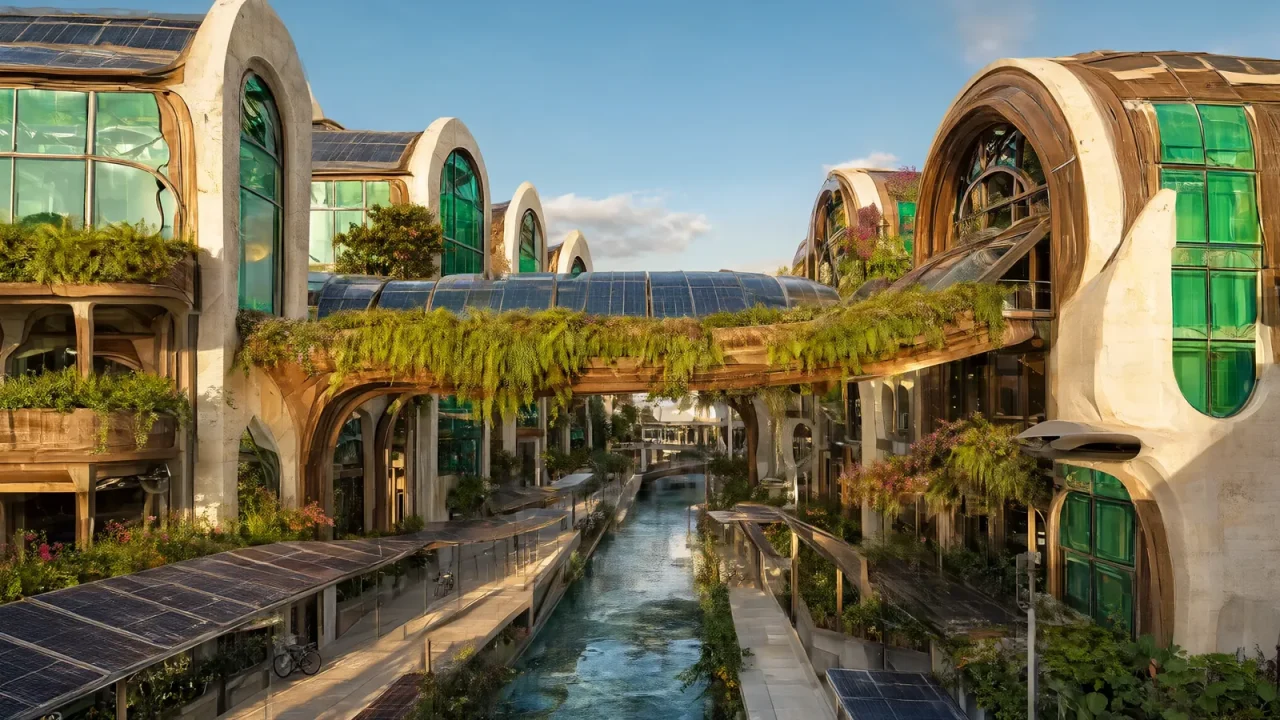
The signature solarpunk aesthetic merges Art Nouveau silhouettes, living foliage, natural timber, photovoltaic glass, luminous greens and blues, and diverse cultural motifs. That architectural kinship reaches straight back to the international Art Nouveau movement (1890–1910 during the Belle Époque), popularized by dealer Siegfried Bing through his Paris gallery Maison de l’Art Nouveau in 1895 after Belgian journal L’Art Moderne first coined the phrase in the 1880s. Inspired by British Arts and Crafts pioneer William Morris, French architectural theorist Eugène-Emmanuel Viollet-le-Duc, and critic John Ruskin, pioneers such as Victor Horta (Brussels’s Hôtel Tassel, completed in 1893), Paul Hankar, and Henry van de Velde championed botanical whiplash curves, wrought iron, luminous skylights, and the German ideal of Gesamtkunstwerk uniting buildings with everyday craft. Hector Guimard carried those organic glass-and-iron motifs onto Paris Métro entrances reaching peak prominence during Paris’s 1900 International Exposition alongside Alphonse Mucha’s graphic posters and glassware from Émile Gallé, René Lalique, and Louis Tiffany. Solarpunk updates that decorative legacy by pairing organic iron-and-glass form with active solar generation and urban biodiversity.
On screen, commentators point to partial touchstones: Marvel Studios’ vision of Wakanda in Black Panther, the island setting of Auroa from Ghost Recon Breakpoint, and Studio Ghibli landmarks Nausicaä of the Valley of the Wind alongside Castle in the Sky. Such worlds remain unusual in mainstream cinema. An analysis of the 44 highest-profile American science-fiction movies found future cities almost uniformly sidelined nature into ornamental gardens or monoculture lawns instead of integrating living ecosystems into civic life.
Foundational Reading List and Worldbuilding Practice
Readers surveying solarpunk books encounter two historical strata—retroactively adopted 20th-century pioneers and explicit 21st-century anthologies and novellas:
- Retroactive precursors: Early novels charting transitions toward ecological societies include Ursula K. Le Guin’s The Dispossessed (1974) and Always Coming Home (1985), Ernest Callenbach’s regional classic Ecotopia (1975), Starhawk’s The Fifth Sacred Thing (1993), and Kim Stanley Robinson’s Pacific Edge (1990).
- Early explicit anthologies: Dedicated solarpunk fiction launched with the 2012 anthology of ecological and fantastical tales set inside a sustainable world (completing a publisher trilogy after Vaporpunk and Dieselpunk). Subsequent milestones included 2015’s Wings of Renewal (blending dragons with sustainability), the 2017 anthology Sunvault, and 2018’s Glass and Gardens.
- Modern novellas & mundane texture: Following a 2018 Tor Books deal, Becky Chambers broadened mainstream readership with the 2021 novella A Psalm for the Wild-Built, followed a year later by A Prayer for the Crown-Shy (2022). Blending mundane science fiction into the subgenre, Nina Munteanu explained in an interview that A Diary in the Age of Water deploys everyday constraints to add “the gritty realism of the mundane.”
Writing in Slate in 2019, Lee Konstantinou described solarpunk authors as championing “ingenuity, generativity, independence, and community” against cyberpunk nihilism and steampunk reaction. Across these narratives, the central “maker-hero” responds when distant authorities fail to address crisis. Authors building original sustainable worlds can track watersheds, decentralized energy grids, and civic customs cleanly using structured worldbuilding tools so ecological mechanics feel lived-in rather than painted on.
Comparing solarpunk against broader climate fiction (shortened to cli-fi by reporter and activist Dan Bloom around 2007–2008 and widened in mainstream press coverage by April 2013) clarifies its distinctive tone. Ecological storytelling stretches from Jules Verne’s polar-axis climate tale The Purchase of the North Pole (1889) and Laurence Manning’s serialized ecological fiction The Man Who Awoke (1933)—a work Isaac Asimov praised for confronting energy limits forty years ahead of 1970s debates—through J. G. Ballard’s flooded and drought-stricken landscapes in The Drowned World (1962) alongside The Burning World (1964), Octavia E. Butler’s cautionary Parable of the Sower (1993), and Margaret Atwood’s Oryx and Crake (2003). While grim cli-fi warns of ecological collapse, Kim Stanley Robinson’s adaptation-focused New York 2140 (2017) and The Ministry for the Future (2020) bridge directly toward solarpunk’s institutional problem-solving. Empirical reader studies noted in climate-fiction scholarship even caution that dystopian warnings like Paolo Bacigalupi’s The Water Knife (2015) can stir reactive dread rather than civic solidarity—underscoring why solarpunk insists on actionable, repair-oriented futures.
Greenwashing and Fake Solarpunk Urbanism
Advocates actively police the line between genuine ecological imagination and corporate aesthetics. Researcher Adam Flynn has cautioned against greenwashing through “fake solarpunk urbanism”—luxury condominiums topped with decorative green roofs that price out existing residents while worsening overall environmental harm.
Lorenzo Domaneschi highlights a parallel institutional dilemma. Unlike corporate ESG frameworks grounded in quantitative audits, solarpunk tests whether communities can viscerally imagine living inside a sustainable civilization. Because a literary and artistic subculture wields no regulatory power, companies can borrow its visual cues of light, greenery, and care for branding without altering extractive operations. Sustaining the subgenre’s integrity therefore depends on keeping decentralized access, repairability, and ecological justice inseparable from its sunlit imagery.
Frequently Asked Questions
What is solarpunk in plain terms?
It is a speculative fiction, visual art, and activist movement envisioning ecologically sustainable futures built on clean energy, DIY craftsmanship, Art Nouveau aesthetics, and decentralized community governance rather than corporate dystopia.
When did the term solarpunk first appear?
An anonymous 2008 blog essay titled “From Steampunk to Solarpunk” coined the word after drawing inspiration from the kite-assisted cargo ship MS Beluga Skysails. Later landmarks include Matt Staggs’s 2009 manifesto, 2014 Tumblr art and Adam Flynn’s Project Hieroglyph notes, the 2019 manifesto, and the 2024 Encyclopedia of Science Fiction entry.
How does solarpunk compare with cyberpunk and steampunk?
Cyberpunk warns against corporate alienation through dark high-tech futures, while steampunk reimagines Victorian history through steam mechanics. Solarpunk looks forward like cyberpunk yet inherits steampunk’s legible, hands-on engineering, redirecting it toward renewable energy and community resilience.
Sources & Archival Attribution
- Solarpunk — Wikipedia (CC BY-SA 4.0, revid 1387506356)
- Speculative fiction — Wikipedia (CC BY-SA 4.0, revid 1387026942)
- Climate fiction — Wikipedia (CC BY-SA 4.0, revid 1388337408)
- Art Nouveau — Wikipedia (CC BY-SA 4.0, revid 1387791950)